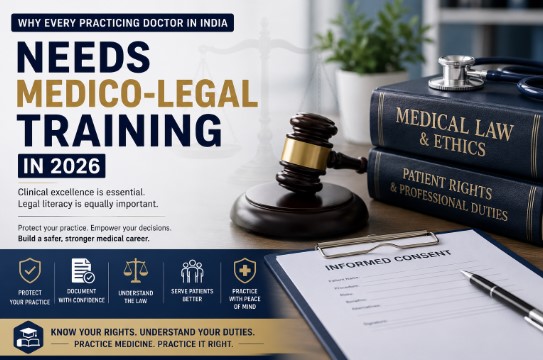
Medical education prepares doctors to diagnose diseases, make complex clinical decisions, and provide appropriate treatment. But one area often receives comparatively less practical attention: understanding the legal and ethical framework surrounding everyday medical practice.
What constitutes valid informed consent? How should medical records be maintained? What are a doctor’s responsibilities regarding patient confidentiality? How should a healthcare professional respond when a patient requests records or when a legal notice arrives?
These are not questions limited to courtroom disputes. They can arise during routine medical practice.
As healthcare becomes increasingly digital, patients become more informed about their rights, and technologies such as telemedicine become more widely integrated into healthcare delivery, medico-legal awareness has become increasingly relevant for practicing doctors.
In 2026, understanding the intersection between medicine, ethics, patient rights, documentation, and applicable legal responsibilities is an important professional competency for doctors across specialties.
The Gap Between Clinical Skill and Legal Awareness
Doctors undergo years of rigorous clinical education and training. However, clinical competence does not automatically provide an understanding of every legal and regulatory responsibility associated with medical practice.
A doctor may be highly experienced in treating patients but still encounter uncertainty around questions such as:
- What constitutes valid informed consent in a particular clinical situation?
- How should important clinical discussions be documented?
- How long should different categories of medical records be retained?
- When can confidential patient information legally or ethically be disclosed?
- How should requests for medical records be handled?
- What should a doctor do after receiving a complaint or legal notice?
- What responsibilities apply when providing teleconsultations?
These issues demonstrate why medico-legal knowledge should not be viewed as something relevant only after a dispute occurs.
Ideally, it should form part of responsible everyday medical practice.
What Medico-Legal Training Actually Covers
Medico-legal training is not about turning doctors into lawyers.
Its purpose is to help healthcare professionals understand the legal and ethical principles that directly affect their clinical work and professional responsibilities.
Depending on the scope of the training, important areas may include:
- Informed consent and appropriate documentation
- Medical records and applicable retention requirements
- Doctor-patient confidentiality and its limitations
- Principles of medical negligence and professional liability
- Consumer protection laws as they relate to healthcare
- Professional regulatory and medical council proceedings
- Patient rights and doctors’ professional responsibilities
- Telemedicine and digital healthcare considerations
- Data privacy and confidentiality in digital health environments
- Ethical decision-making in clinical practice
- Responding appropriately to complaints and legal notices
The objective is not to enable doctors to manage complex legal matters without professional legal advice. Rather, it is to help them recognise potential medico-legal issues, follow appropriate processes, maintain better documentation, and understand when specialist legal guidance may be necessary.
Why Medico-Legal Awareness Matters in 2026
The environment in which doctors practise has changed considerably.
Patients today have greater access to medical information and increased awareness of healthcare rights. Digital communication has also changed how patients interact with doctors and healthcare institutions.
At the same time, telemedicine, electronic health records, online consultations, digital prescriptions, and other technology-enabled healthcare services have introduced new considerations around privacy, consent, documentation, and professional responsibility.
Social media has added another dimension.
A disagreement or negative patient experience can sometimes become public before a formal complaint or legal proceeding begins. Doctors and healthcare institutions therefore need to understand not only their clinical responsibilities but also the importance of appropriate communication and professional conduct when disputes arise.
Medico-legal literacy can help doctors approach these situations with greater awareness of appropriate procedures rather than responding impulsively under pressure.
Common Situations Where Medico-Legal Awareness Matters
Medico-legal knowledge becomes relevant in many ordinary clinical situations.
Obtaining Informed Consent
A signed consent form alone does not necessarily represent the entire consent process.
Depending on the procedure and circumstances, informed consent involves appropriate communication about the proposed treatment, relevant risks, expected benefits, and available alternatives where applicable.
Understanding how consent should be obtained and documented is an important part of responsible medical practice.
Maintaining Medical Records
Medical records serve both clinical and professional purposes.
Clear documentation can help demonstrate the patient’s clinical history, findings, treatment decisions, advice provided, and follow-up.
Doctors should also understand that record-retention requirements may vary depending on the nature of the records and applicable professional, institutional, or statutory requirements.
Responding to Requests for Medical Records
Patients, authorised representatives, or legal authorities may request access to medical records in appropriate circumstances.
Healthcare professionals should understand the applicable procedures, timelines, confidentiality considerations, and documentation involved in responding to such requests.
Receiving a Patient Complaint
Complaints should be handled calmly and professionally.
An emotional or defensive response can complicate communication. Understanding the appropriate internal and professional processes can help doctors respond in a structured manner while preserving relevant records and seeking appropriate advice when necessary.
Receiving a Legal Notice
A legal notice should neither be ignored nor answered impulsively.
Doctors should understand the importance of preserving documentation, informing relevant institutional authorities where applicable, reviewing professional indemnity coverage, and obtaining qualified legal advice.
Medico-legal training can help doctors recognise the appropriate first steps without attempting to replace the role of a lawyer.
Practising Telemedicine
Telemedicine has made healthcare more accessible, but it also creates specific considerations related to patient identification, consent, prescriptions, confidentiality, documentation, and data handling.
Doctors providing remote consultations should remain familiar with the professional guidelines and legal requirements applicable to their practice.
Documentation Is More Than Defensive Medicine
Medical documentation is sometimes discussed primarily as a way to protect doctors during disputes.
But good documentation serves a broader purpose.
Accurate records support continuity of care, help other healthcare professionals understand previous clinical decisions, reduce communication gaps, and create a clearer account of the patient’s treatment journey.
From a medico-legal perspective, documentation can also provide important evidence of what was observed, discussed, advised, and decided at a particular point in time.
The goal should not be to practise medicine defensively.
The goal should be to maintain clear, accurate, timely, and appropriate records as part of good clinical practice.
Understanding Medical Negligence
One of the most important areas of medico-legal education is understanding the distinction between an adverse medical outcome and medical negligence.
Medicine inherently involves uncertainty and risk.
A patient experiencing a complication or an unsuccessful treatment outcome does not automatically mean that negligence occurred.
Questions of negligence generally require consideration of factors such as the professional duty of care, the applicable standard of care, the doctor’s actions in the circumstances, and whether any breach contributed to the alleged harm.
Doctors do not need to become legal experts in negligence law. However, understanding its basic principles can help them appreciate why appropriate clinical decision-making, patient communication, informed consent, and documentation are important.
Medico-Legal Awareness Is Relevant Across Specialties
It is easy to assume that medico-legal training matters primarily to surgeons, obstetricians, cosmetic practitioners, or doctors performing high-risk procedures.
In reality, medico-legal issues can arise across almost every area of healthcare.
General practitioners manage confidentiality and medical records.
Physicians obtain consent and communicate treatment risks.
Radiologists and pathologists manage sensitive diagnostic information.
Telemedicine providers navigate digital communication and documentation.
Hospital administrators deal with complaints, patient rights, and institutional responsibilities.
Aesthetic practitioners must manage consent, expectations, documentation, and procedure-related risks.
The specific risks may differ, but the underlying need for legal and ethical awareness remains relevant across medical practice.
Building Medico-Legal Literacy Without Disrupting Clinical Practice
Developing medico-legal awareness does not require every doctor to pursue a law degree.
Doctors can strengthen their understanding through structured continuing education, professional workshops, case-based learning, updated guidelines, and medico-legal training designed around real clinical situations.
Case-based learning can be particularly useful because it allows healthcare professionals to understand how legal and ethical principles apply in practical scenarios rather than learning them only as abstract concepts.
The objective should be to build practical literacy that doctors can apply to everyday areas such as consent, documentation, confidentiality, patient communication, complaints, and professional decision-making.
Medico-legal education should also be viewed as an ongoing process.
Healthcare laws, professional guidelines, technology, and regulatory expectations can evolve. Doctors therefore benefit from periodically updating their knowledge rather than relying entirely on practices learned earlier in their careers.
The Bottom Line
Clinical excellence remains the foundation of medical practice, but modern healthcare requires doctors to understand more than diagnosis and treatment alone.
Doctors also operate within a framework of patient rights, professional ethics, documentation responsibilities, confidentiality requirements, regulatory standards, and applicable laws.
Medico-legal training can help bridge the gap between clinical expertise and these wider professional responsibilities.
The objective is not to make doctors fearful of legal consequences or encourage defensive medicine. It is to help them practise with greater awareness, communicate more effectively, maintain appropriate records, understand their responsibilities, and recognise situations where professional legal guidance may be required.
In 2026, medico-legal literacy should increasingly be viewed not merely as a response to legal risk, but as part of responsible, ethical, and professionally informed medical practice.
About the Author
Dr. Arvinder Singh is a postgraduate medical doctor with qualifications in medicine, management, and law. He holds an LLB and has professional training in legal arbitration, alongside more than 25 years of experience in healthcare. His areas of professional expertise include medical law, healthcare education, clinical cosmetology training, and medical business coaching.
Through his work as an educator and trainer, Dr. Singh focuses on helping healthcare professionals develop practical knowledge beyond clinical medicine, including medical law, ethics, professional communication, and healthcare leadership. Doctors and healthcare professionals interested in strengthening their understanding of medico-legal responsibilities can explore his Medical Law & Ethics course for doctors.